

There are now more Shariah-compliant Exchange Traded Funds (ETFs) than ever but they don’t
all follow the same rulebook, and they definitely don’t all charge the same fees. Here’s a
clear-eyed comparison of the major halal ETFs available in 2026, and how to pick the right mix
for your portfolio.
Written by the Manzil Team
Not long ago, “halal investing” meant either painstakingly screening stocks yourself or settling
for one or two expensive mutual funds. That era is over. Today, Muslim investors can build a
fully diversified, Shariah-compliant portfolio, U.S. equities, global stocks, real estate, even fixed
income , entirely with low-cost ETFs.
But more choice brings a new problem: the funds look similar on the surface while differing in
ways that matter. Different certifiers apply different financial-ratio screens, so the same company
can appear in one halal ETF and be excluded from another. Fees range from 0.40% to 0.65% ,
a gap that quietly compounds into real money over decades. This guide breaks down what’s
actually available and how to compare.
First, a quick refresher: what makes an ETF halal?
A halal ETF tracks an index screened according to Shariah principles. Sectors like conventional
banking and insurance, alcohol, gambling, tobacco, weapons, and adult entertainment are
excluded outright, and the remaining companies must pass financial ratio tests , typically
keeping interest-bearing debt and interest income below defined thresholds. Any incidental
impermissible income is disclosed so investors can purify it through charitable giving.
This is also why popular conventional funds like VOO, SPY, and QQQ don’t qualify: they hold
banks, alcohol producers, and interest-bearing cash alongside everything else. And one
category is off the table entirely, leveraged ETFs, which use debt and derivatives to amplify
returns, are considered impermissible regardless of what they hold.
How we compare halal ETFs
Five things matter most when evaluating any halal ETF:
Certification and methodology. Who screens the index, and against what standard? AAOIFI is
the most widely recognized benchmark, but certifiers interpret ratios differently, which is why
fund holdings diverge.
Expense ratio. The annual fee you pay, every year, regardless of performance. Small
differences compound: on steady contributions over 30 years, a 0.15% fee gap can cost an
investor tens of thousands of dollars.
Breadth of holdings. More holdings generally means better diversification and less
single-stock risk. Some halal funds hold 100 companies; others hold 600+.
Scale and liquidity. Larger funds with tighter bid-ask spreads are cheaper to trade and less
likely to close.
Purification burden. How much of the fund’s income needs to be donated to cleanse incidental
non-compliant revenue. Funds report this; the lower, the simpler your life.
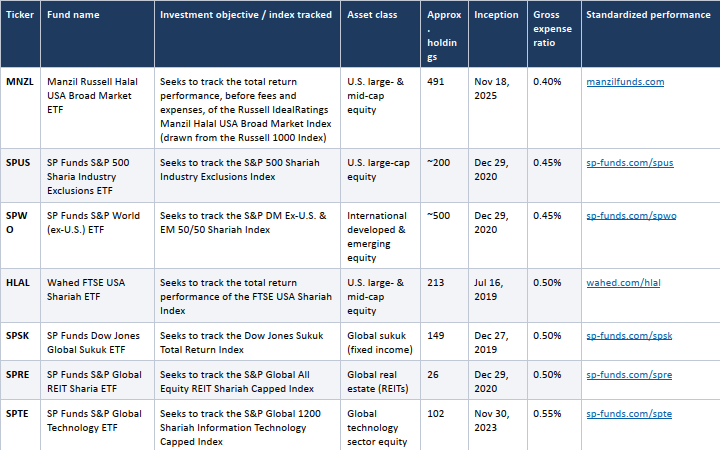

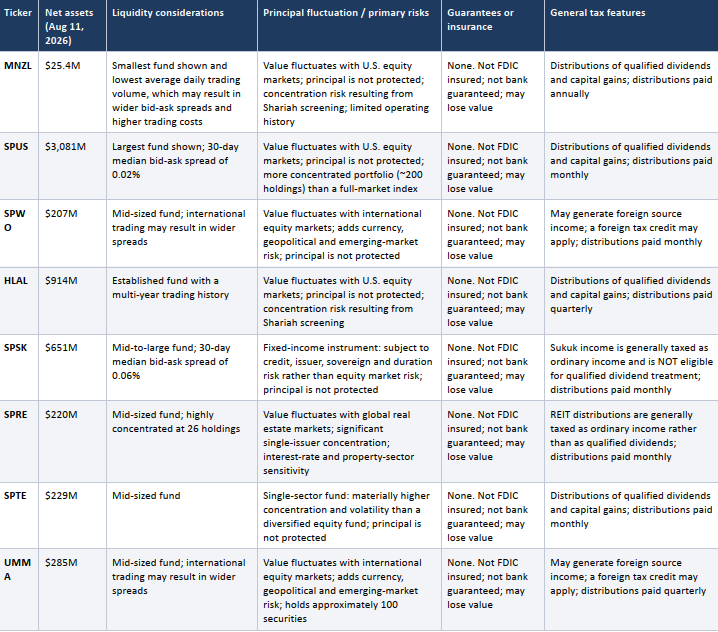
Table 2 : Liquidity, risk, guarantees and tax features
The major halal ETFs at a glance
Expense ratios sourced from fund issuers, August 2026.
U.S. equity: the core of most portfolios
MNZL , Manzil Halal USA Broad Market ETF (0.40%). The lowest-cost halal equity ETF on the
U.S. market, and the broadest. MNZL tracks the Russell IdealRatings Manzil Halal USA Broad
Market Index , built from the Russell 1000, screened to AAOIFI standards , giving investors
exposure to roughly 600 U.S. large- and mid-cap companies. It’s also the only fund on this list
with an additional human rights screen, applying American Friends Service Committee criteria to
exclude companies complicit in grave violations. If you want maximum U.S. market coverage at
minimum cost, with values screening that goes beyond the standard exclusions, this is the one
to beat.
SPUS , SP Funds S&P 500 Shariah Industry Exclusions ETF (0.45%). The largest halal ETF
by assets and the most established of the U.S. options. It holds the roughly 200 S&P 500
companies that pass the S&P Shariah screen. Deep liquidity and a multi-year track record are
its calling cards; the trade-off is a narrower, more concentrated portfolio than a broad-market
fund.
HLAL , Wahed FTSE USA Shariah ETF (0.50%). The pioneer , launched in 2019 as one of the
first U.S.-listed halal ETFs. It tracks the FTSE Shariah USA Index. A solid fund, though it now
costs more than both MNZL and SPUS for similar U.S. large-cap exposure.
Going global
SPWO (0.45%) covers international markets , developed ex-U.S. and emerging markets in a
50/50 blend , making it a natural companion to a U.S. core holding. UMMA (0.65%) offers a
similar international mandate via the Dow Jones Islamic Market International Titans 100, but it’s
the most expensive fund on this list and holds only about 100 companies.
Income and specialty
SPSK (0.50%) is the closest thing to a “halal bond fund”: a portfolio of investment-grade,
dollar-denominated sukuk that can steady a portfolio the way conventional bonds do , without
the interest. SPRE (0.50%) holds Shariah-compliant global REITs for real estate exposure and
income. SPTE (0.55%) concentrates on global technology; just be aware that most halal equity
funds are already tech-heavy, so a dedicated tech fund is a tilt, not a diversifier. It has also carried one of the higher purification burdens among these funds , worth checking before you
buy.
Putting it together
You don’t need all eight. Most investors can build a complete halal portfolio with two or three
funds:
- Simple: a broad U.S. core like MNZL, full stop.
- Balanced: a U.S. core (MNZL) + international (SPWO) + sukuk (SPSK) for stability.
- Growth: U.S. core + international, with real estate (SPRE) as a satellite.
Whatever mix you choose, favour broad, certified, low-cost funds for the core , and remember
that the expense ratio is the one variable you control completely.
A note for Canadian investors: these are U.S.-listed ETFs, and all are purchasable through
most Canadian brokerages. On the TSX, the Wealthsimple Shariah World Equity Index ETF
(WSHR) is the main domestic option for global halal equity exposure.
The bottom line
The halal ETF market has matured to the point where cost and quality , not scarcity , drive the
decision. The Manzil Halal USA Broad Market ETF (MNZL) was built for exactly this moment:
the broadest U.S. halal equity exposure available, AAOIFI-certified with an annual Shariah
Compliance Certificate, a human rights screen no peer offers, and the lowest fee in its class at
0.40%.
Faith-aligned investing no longer asks you to compromise on diversification, cost, or conviction.
Pick your funds, automate your contributions, and let the market do the rest.
Learn more about MNZL, including holdings and documents, at manzilfunds.com.
CTA: Download Manzil Invest
This article is for information purposes only and does not constitute financial, legal, tax, or
religious advice. Fund details, including expense ratios, are as of August 2026 and subject to
change , always confirm with the fund issuer. Consult a qualified advisor about your individual
circumstances.
Important disclosures
Investors should consider the investment objectives, risks, charges and expenses carefully before investing. This and other information is contained in the Fund’s prospectus, which may be obtained at manzilfunds.com. Please read the prospectus carefully before investing.
Investing involves risk, including possible loss of principal. Past performance does not guarantee future results. Performance data quoted represents past performance. Current performance may be lower or higher than the performance quoted. Investment return and principal value will fluctuate so that shares, when redeemed, may be worth more or less than their original cost. Standardized performance current to the most recent month-end is available at manzilfunds.com.
This article contains comparisons to other exchange-traded funds. The funds referenced differ from MNZL in investment objective, index methodology, portfolio composition, number of holdings, expense structure, liquidity, operating history, risk profile and tax treatment, as set out in the tables above. These differences are material and investors should not rely on any single factor, including expense ratio, in evaluating the funds. Expense ratio is only one component of total cost and does not determine total return. Comparative information regarding third-party funds is derived from publicly available issuer materials as of August 11, 2026 and has not been independently verified; it is subject to change. Manzil is not affiliated with, and does not endorse, any third-party fund referenced.
Standardized performance for each fund referenced is available at that fund’s website, linked in the tables above.
Shariah screening reduces the investable universe and may cause the Fund to forgo investment opportunities available to funds without such restrictions, and to underperform funds that do not apply similar screens. There is no guarantee that a fund will achieve its investment objective. Diversification does not assure a profit or protect against loss in a declining market.
This material is for informational and educational purposes only and does not constitute an offer to sell or a solicitation of an offer to buy any security, nor investment, legal, tax or religious advice. It does not take into account any individual’s particular circumstances. Investors should consult their own financial, tax and religious advisors before making investment decisions.